CRITICAL THINKING: CONSIDER THE VERDICT, 6/E
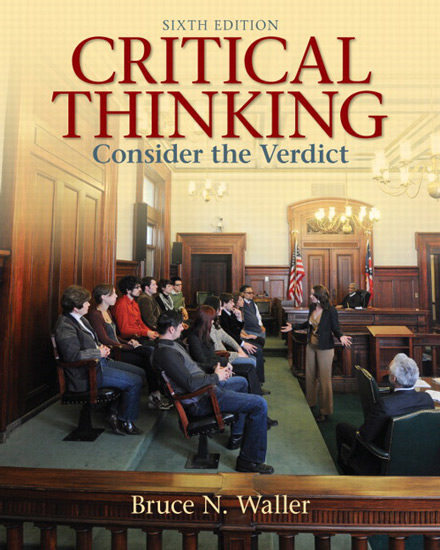
Critical Thinking: Consider the Verdict, 6/E
Description
Integrating Logic Skills into the Critical Decision-Making Process
Organized around lively and authentic examples drawn from jury trials, contemporary political and social debate, and advertising, Critical Thinking: Consider the Verdict shows students how to detect fallacies and how to examine and construct cogent arguments.
Accessible and reader friendly–yet thorough and rigorous–Critical Thinking: Consider the Verdict shows students how to integrate all logic skills into the critical decision-making process, and construct arguments from examples gained through the study of contemporary and historic debates, both legal and popular.
Teaching and Learning Experience
Personalize Learning - MyThinkingLab delivers proven results in helping students succeed, provides engaging experiences that personalize learning, and comes from a trusted partner with educational expertise and a deep commitment to helping students and instructors achieve their goals.
Improve Critical Thinking - “Argue Your Case” segments, “Consider the Verdict” boxes, real-life examples and cases, and an optional chapter on “Thinking Critically about Statistics” all encourage students to examine their assumptions, discern hidden values, evaluate evidence, assess their conclusions, and more!
Engage Students - Critical Thinking: Consider the Verdict’s readable, conversational style, wealth of exercises, suggested Website resources, glossary (and more!) allows your students to easily read, understand and engage with the text.
Support Instructors - Teaching your course just got easier! You can create a Customized Text or use our Instructor’s Manual, Electronic “MyTest” Test Bank or PowerPoint Presentation Slides. Plus, instructors find it easy to teach from Critical Thinking: Consider the Verdict because students are given an argument context that orients them to new material and helps them place it in a familiar setting — giving you the freedom to present different, complimentary material in class!
INTEGRATING LOGIC SKILLS INTO THE CRTICAL DECISION-MAKING PROCESS
-
Critical Thinking: Consider the Verdict focuses on systematic skills rather than isolated techniques. Students are forced to make rulings concerning an argument. (e.g.: Is this argument relevant? Is the burden of proof appropriately placed?) Students weigh competing arguments to determine which is the strongest, and construct their own arguments by analogy using cited judicial precedents. Additionally, they find new topics less intimidating; e.g.: the material may be new, but it is in a setting with familiar landmarks. (ex. p. 49)
PERSONALIZE LEARNING
-
MyThinkingLab is an online resource that contains book-specific practice tests, chapter summaries, learning objectives, flashcards, weblinks, MySearchLab, a complete E-book and media-rich activities that enhance topics covered in Critical Thinking: Consider the Verdict 6/e.
-
The Pearson eText lets students access their textbook anytime, anywhere, and any way they want–including listening online or downloading to iPad.
-
A personalized study plan for each student promotes better critical-thinking skills, and helps students succeed in the course and beyond.
-
Assessment tied to every video, application, and chapter enables both instructors and students to track progress and get immediate feedback. With results feeding into a powerful gradebook, the assessment program helps instructors identify student challenges early–and find the best resources with which to help students.
-
Class Prep collects the very best class presentation resources in one convenient online destination, so instructors can keep students engaged throughout every class.
IMPROVE CRITICAL THINKING
-
“Argue Your Case” segments give students practice in developing cogent and compelling arguments for a specific position, and helps them develop an appreciation of the importance of good arguments and a sense of the positive benefits of critical thinking in addition to simple protection against being fooled by fallacies. (ex. p. 254)
-
“Consider the Verdict” boxes-integrated into the text and exercises-give students opportunities to evaluate, compare, and critique arguments and competing arguments. (ex. p. 80)
-
Student interest is maintained when real-life examples and cases are drawn from court trials, judicial reviews, advertising, political campaigns, and controversial social issues. (ex. p. 79)
-
An optional chapter on “Thinking Critically about Statistics”—Chapter 17—examines the use and misuse of surveys, averages, and statistical comparisons.
ENGAGE STUDENTS
-
Critical Thinking: Consider the Verdict’s readable, conversational style with substance avoids a heavy “textbook” feel and tone. It allows students to easily read and understand the text on their own.
-
A wealth of exercises—including chapter-end and longer comprehensive review exercises drawn from real-life cases involving trials, judicial reviews, advertising, political campaigns, and arguments over controversial social issues—maintain student interest by reflecting real-life situations. (ex. p. 113)
-
Suggested Website resources are available for many chapters. They encourage students’ study and exploration of further materials. (ex. p. 114)
-
A glossary provides students with a handy source of reference and easy access to all the terms and definitions used throughout the text.
SUPPORT INSTRUCTORS
-
Instructors find it easy to teach from Critical Thinking: Consider the Verdict because students are given an argument context that orients them to new material and helps them place it in a familiar setting — giving you the freedom to present different, complimentary material in class!
-
Instructor’s Manual with Tests (0205158757): For each chapter in the text, this resource provides a detailed outline and test questions in true/ false, fill-in-the-blank, and short answer formats. For easy access, this manual is available within the instructor section of MyThinkingLab for Critical Thinking: Consider the Verdict, 6/e,or at www.pearsonhighered.com/irc.
-
MyTest (0205158781): This computerized software will allow you to create your own personalized exams, edit any or all of the existing test questions, and add new questions. Other special features of the program include random generation of test questions, creation of alternate versions of the same test, scrambling question sequence, and test preview before printing. For easy access, this software is available atwww.pearsonhighered.com/irc.
-
PowerPoint Presentation Slides for Critical Thinking: Consider the Verdict 6/e (0205158773): These PowerPoint slides help you convey critical thinking principles in a clear and engaging way. For easy access, they are available within the instructor section of MyThinkingLab for Critical Thinking: Consider the Verdict 6/e,or at www.pearsonhighered.com/irc.
IN THIS SECTION:
1.) BRIEF
2.) COMPREHENSIVE
2.) COMPREHENSIVE
BRIEF TABLE OF CONTENTS
Table of Contents
Preface
Acknowledgments
Preface
Acknowledgments
Chapter 1 Introduction
Chapter 2 A Few Important Terms
Chapter 3 Ad Hominem Arguments
Chapter 4 The Second Deadly Fallacy: The Strawman Fallacy
Chapter 5 What’s the Question?
Chapter 3 Ad Hominem Arguments
Chapter 4 The Second Deadly Fallacy: The Strawman Fallacy
Chapter 5 What’s the Question?
Chapter 6 Relevant and Irrelevant Reasons
Chapter 7 Analyzing Arguments
Chapter 8 The Burden of Proof
Chapter 7 Analyzing Arguments
Chapter 8 The Burden of Proof
Chapter 9 Language and its Pitfalls
Chapter 10 Appeal to Authority
Cumulative Exercises One
(Chapters 1 through 10)
Chapter 10 Appeal to Authority
Cumulative Exercises One
(Chapters 1 through 10)
Chapter 11 Arguments by Analogy
Chapter 12 Some Distinctive Arguments and Potential Pitfalls: Slippery Slope, Dilemma, and Golden Mean Arguments
Chapter 13 Begging the Question
Cumulative Exercises Two
(Chapters 1 through 13)
Cumulative Exercises Two
(Chapters 1 through 13)
Chapter 14 Necessary and Sufficient Conditions
Chapter 15 Scientific and Causal Reasoning
Chapter 15 Scientific and Causal Reasoning
Chapter 16 The Truth, the Whole Truth, and Nothing but the Truth
Cumulative Exercises Three
Chapters 1 through 16)
Chapters 1 through 16)
Chapter 17 Thinking Critically about Statistics
Chapter 18 Symbolic Sentential Logic
Chapter 19 Arguments about Classes
Key Terms
Answers to Selected Exercises
Index
Chapter 18 Symbolic Sentential Logic
Chapter 19 Arguments about Classes
Key Terms
Answers to Selected Exercises
Index
COMPREHENSIVE TABLE OF CONTENTS
Table of Contents
Preface
Acknowledgments
Preface
Acknowledgments
Chapter 1 Introduction
Critical Thinking in Everyday Life
Play Fair
Seating a Jury
Jury Research: Eliminating or Selecting Bias?
Impartial Critical Thinking
Jury Research: Eliminating or Selecting Bias?
Impartial Critical Thinking
Adversarial Critical Thinking
Cooperative Critical Thinking
Exercises
Additional Reading
Online Resources
Additional Reading
Online Resources
Chapter 2 A Few Important Terms
Arguments
Statements
Arguments
Statements
Exercise 2-1
Premises and Conclusions
Premises and Conclusions
Exercise 2-2
Deductive and Inductive Arguments
Deductive and Inductive Arguments
Exercise 2-3
Deduction, Validity, and Soundness
Induction, Strong Arguments, and Cogent Arguments
Deduction, Validity, and Soundness
Induction, Strong Arguments, and Cogent Arguments
Exercises 2-4, 2-5
Review Questions
Online Resources
Chapter 3 Ad Hominem Arguments
The Ad Hominem Fallacy
Nonfallacious Ad Hominem Arguments
Ad Hominem and Testimony
Distinguishing Argument from Testimony
The Ad Hominem Fallacy
Nonfallacious Ad Hominem Arguments
Ad Hominem and Testimony
Distinguishing Argument from Testimony
Exercise 3-1
Tricky Types of Ad Hominem
Bias Ad Hominem
Inconsistency and Ad Hominem
Psychological Ad Hominem
Inverse Ad Hominem
Attacking Arguments
Exercises 3-2
Tricky Types of Ad Hominem
Bias Ad Hominem
Inconsistency and Ad Hominem
Psychological Ad Hominem
Inverse Ad Hominem
Attacking Arguments
Exercises 3-2
Review Questions
Additional Reading
Internet Resources
Chapter 4 The Second Deadly Fallacy: The Strawman Fallacy
Strawman
The Principle of Charity
The Strawman Fallacy
Special Strawman Varieties
Strawman
The Principle of Charity
The Strawman Fallacy
Special Strawman Varieties
Limits on Critical Thinking
Exercises 4-1 and 4-2
Additional Reading
Chapter 5 What’s the Question?
Determine the Conclusion
What Is the Exact Conclusion?
Determine the Conclusion
What Is the Exact Conclusion?
Exercises 5-1, 5-2, 5-3, 5-4
Review Question
Chapter 6 Relevant and Irrelevant Reasons
Premises Are Relevant or Irrelevant Relative to the Conclusion
Irrelevant Reason Fallacy
The Red Herring Fallacy
Premises Are Relevant or Irrelevant Relative to the Conclusion
Irrelevant Reason Fallacy
The Red Herring Fallacy
Exercises 6-1 and 6-2
Review Questions
Additional Reading
Chapter 7 Analyzing Arguments
Argument Structure
Convergent Arguments
Linked Arguments
Argument Structure
Convergent Arguments
Linked Arguments
Subarguments
Exercises 7-1, 7-2 and 7-3
Assumptions: Their Use and Abuse
Legitimate Assumptions
Enthymemes
Illegitimate Assumptions
Exercises 7-1, 7-2 and 7-3
Assumptions: Their Use and Abuse
Legitimate Assumptions
Enthymemes
Illegitimate Assumptions
Exercise 7-4
Review Questions
Additional Reading
Chapter 8 The Burden of Proof
Who Bears the Burden of Proof?
Appeal to Ignorance
The Burden of Proof in the Courtroom
Presumption of Innocence
When the Defendant Does Not Testify
Juries and the Burden of Proof
Unappealing Ignorance
Who Bears the Burden of Proof?
Appeal to Ignorance
The Burden of Proof in the Courtroom
Presumption of Innocence
When the Defendant Does Not Testify
Juries and the Burden of Proof
Unappealing Ignorance
Exercises 8-1, 8-2, 8-3, 8-4, 8-5, 8-6, 8-7
Review Questions
Additional Reading
Chapter 9 Language and its Pitfalls
Defintions
Stipulative Definitions
Controversial Definitions
Defintions
Stipulative Definitions
Controversial Definitions
Deceptive Language
The Fallacy of Ambiguity
Amphiboly
Exercises 9-1, 9-2, and 9-3
Additional Reading
Internet Resources
Chapter 10 Appeal to Authority
Authorities as Testifiers
Conditions for Legitimate Appeal to Authority
Popularity and Tradition
Exercise 10-1
Authorities as Testifiers
Conditions for Legitimate Appeal to Authority
Popularity and Tradition
Exercise 10-1
Review Questions
Additional Reading
Cumulative Exercises One
(Chapters 1 through 10)
Chapter 11 Arguments by Analogy
Figurative Analogy
Deductive Argument by Analogy
Figurative Analogy
Deductive Argument by Analogy
Exercise 11-1
The Fallacy of Faulty Analogy
The Fallacy of Faulty Analogy
Exercises 11-2 and 11-3
Analyzing a Deductive Argument by Analogy
Analyzing a Deductive Argument by Analogy
Deductive Arguments by Analogy and Cooperative Critical Thinking
The Fallacy of Analogical Literalism
Caution! Watch for Analogies That Look Like Slippery Slopes!
Inductive Arguments by Analogy
The Fallacy of Analogical Literalism
Caution! Watch for Analogies That Look Like Slippery Slopes!
Inductive Arguments by Analogy
Exercises 11-4, 11-5, 11-7, 11-7, 11-8, 11-9, and 11-10
Review Questions
Chapter 12 Some Distinctive Arguments and Potential Pitfalls: Slippery Slope, Dilemma, and Golden Mean Arguments
Slippery Slope
Separating Slippery Slopes from Strawmen
Slippery Slope
Separating Slippery Slopes from Strawmen
The Slippery Slope Fallacy
Genuine Slippery Slopes
Exercises 12-1and 12-2
Genuine Slippery Slopes
Exercises 12-1and 12-2
Dilemmas, False and True
Genuine Dilemmas
False Dilemmas
Genuine Dilemmas
False Dilemmas
Dilemmas in Conditional Form
False Dilemma Combined with Strawman
Consider the Possibilities
False Dilemma Combined with Strawman
Consider the Possibilities
Exercise 12-3
Golden Mean
The Golden Mean Fallacy
Constructing Golden Mean Fallacies
Exercise 12-4
Golden Mean
The Golden Mean Fallacy
Constructing Golden Mean Fallacies
Exercise 12-4
Review Questsions
Additional Reading
Additional Reading
Internet Resources
Chapter 13 Begging the Question
The Problem with Question-Begging Arguments
The Problem with Question-Begging Arguments
A New and Confusing Use of “Begs the Question”
Subtle Forms of Question Begging
Synonymous Begging the Question
Generalization Begging the Question
Circular Begging the Question
Subtle Forms of Question Begging
Synonymous Begging the Question
Generalization Begging the Question
Circular Begging the Question
False Charges of Begging the Question
Self-Sealing Arguments
Complex Questions
Self-Sealing Arguments
Complex Questions
Exercises 13-1 and 13-2
Review Questions
Additional Reading
Cumulative Exercises Two
(Chapters 1 through 13)
Chapter 14 Necessary and Sufficient Conditions
Necessary Conditions
Distinguishing Necessary from Sufficient Conditions
Sufficient Conditions
Necessary and Sufficient Conditions in Ordinary Language
Necessary Conditions
Distinguishing Necessary from Sufficient Conditions
Sufficient Conditions
Necessary and Sufficient Conditions in Ordinary Language
Ex Exercises 14-1, 14-2, and 14-3
Conditional Statements
Alternative Ways of Stating Necessary and Sufficient Conditions
Both Necessary and Sufficient
Conditional Statements
Alternative Ways of Stating Necessary and Sufficient Conditions
Both Necessary and Sufficient
Exe Exercises 14-4 and 14-5
Valid Inferences from Necessary and Sufficient Conditions
Modus Ponens
Modus Tollens
Fallacies Based on Confusion between Necessary and Sufficient Conditions
The Fallacy of Denying the Antecedent
The Fallacy of Affirming the Consequent
Detecting Argument Forms
Exercises 14-6, 14-7, and 14-8
Valid Inferences from Necessary and Sufficient Conditions
Modus Ponens
Modus Tollens
Fallacies Based on Confusion between Necessary and Sufficient Conditions
The Fallacy of Denying the Antecedent
The Fallacy of Affirming the Consequent
Detecting Argument Forms
Exercises 14-6, 14-7, and 14-8
Review Questions
Chapter 15 Scientific and Causal Reasoning
Distinguishing Causation from Correlation
Distinguishing Causation from Correlation
Exercise 15-1
The Questionable Cause Fallacy
The Questionable Cause Fallacy
Exercise 15-2
The Method of Science
Randomized Studies and Prospective Studies
Making Predictions
When Predictions Go Wrong
Faulty “Scientific” Claims
The Method of Science
Randomized Studies and Prospective Studies
Making Predictions
When Predictions Go Wrong
Faulty “Scientific” Claims
Occam’s Razor
Confirmation Bias
Scientific Integrity, Scientific Cooperation, and Research Manipulation
Exercise 15-3
Review Questions
Additional Reading
Internet Resources
Chapter 16 The Truth, the Whole Truth, and Nothing but the Truth
Eyewitness Testimony
Potential Sources of Eyewitness Error
Judging the Honesty of a Witness
Eyewitness Testimony
Potential Sources of Eyewitness Error
Judging the Honesty of a Witness
Exercise 16-1
The Whole Truth
Are the Premises True?
Digging for Truth
Consider the Source
The Whole Truth
Are the Premises True?
Digging for Truth
Consider the Source
Exercise 16-2
Review Questions
Additional Reading
Online Resources
Cumulative Exercises Three
Chapters 1 through 16)
Chapters 1 through 16)
Chapter 17 Thinking Critically about Statistics
All Children Are Above Average
Empty Statistics
Finding the Appropriate Context
Caught Off Base
Statistical Apples and Oranges
Statistical Half-Truths
Sample Size and “Statistical Significance”
All Children Are Above Average
Empty Statistics
Finding the Appropriate Context
Caught Off Base
Statistical Apples and Oranges
Statistical Half-Truths
Sample Size and “Statistical Significance”
How to Make Your Study Yield the Results You Want
Exercises 17-1
Surveys
Exercise 17-2
Additional Reading
Online Resources
Chapter 18 Symbolic Sentential Logic
Truth-Functional Definitions
Negation
Disjunction
Conjunction
Conditional
Material Implication
Truth-Functional Definitions
Negation
Disjunction
Conjunction
Conditional
Material Implication
Exercise 18-1
Testing for Validity and Invalidity
Testing for Validity and Invalidity
Exercise 18-2
Punctuation
Punctuation
Exercise 18-3
The Truth-Table Method of Testing for Validity
The Truth-Table Method of Testing for Validity
ExExercise 18-4
The Short-Cut Method for Determining Validity or Invalidity
The Short-Cut Method for Determining Validity or Invalidity
Exercises 18-5, 18-6, and 18-7
Review Questions
Chapter 19 Arguments about Classes
Types of Categorical Propositions
Types of Categorical Propositions
Exercise 19-1
Relations among Categorical Propositions
Venn Diagrams
Diagramming Statements
Diagramming Arguments
Relations among Categorical Propositions
Venn Diagrams
Diagramming Statements
Diagramming Arguments
Exercise 19-2
Translating Ordinary-Language Statements into Standard-Form Categorical Propositions
Translating Ordinary-Language Statements into Standard-Form Categorical Propositions
Exercise 19-3
Reducing the Number of Terms
Reducing the Number of Terms
Exercises 19-4 and 19-5
Review Questions
Consider Your Verdict
Comprehensive Critical Thinking in the Jury Room
Case One: Commonwealth v. Moyer
Judge Carroll’s Summation and Charge to the Jury
Case Two: State v. Ransom
Judge Schwebel’s Summation and Charge to the Jury
Key Terms
Answers to Selected Exercises
Index
Comprehensive Critical Thinking in the Jury Room
Case One: Commonwealth v. Moyer
Judge Carroll’s Summation and Charge to the Jury
Case Two: State v. Ransom
Judge Schwebel’s Summation and Charge to the Jury
Key Terms
Answers to Selected Exercises
Index
ISBN-10: 0205158668
ISBN-13: 9780205158669
Publisher: Pearson
Copyright: 2012
Format: Paper; 480 pp
Published: 07/11/2011
Paylaş